
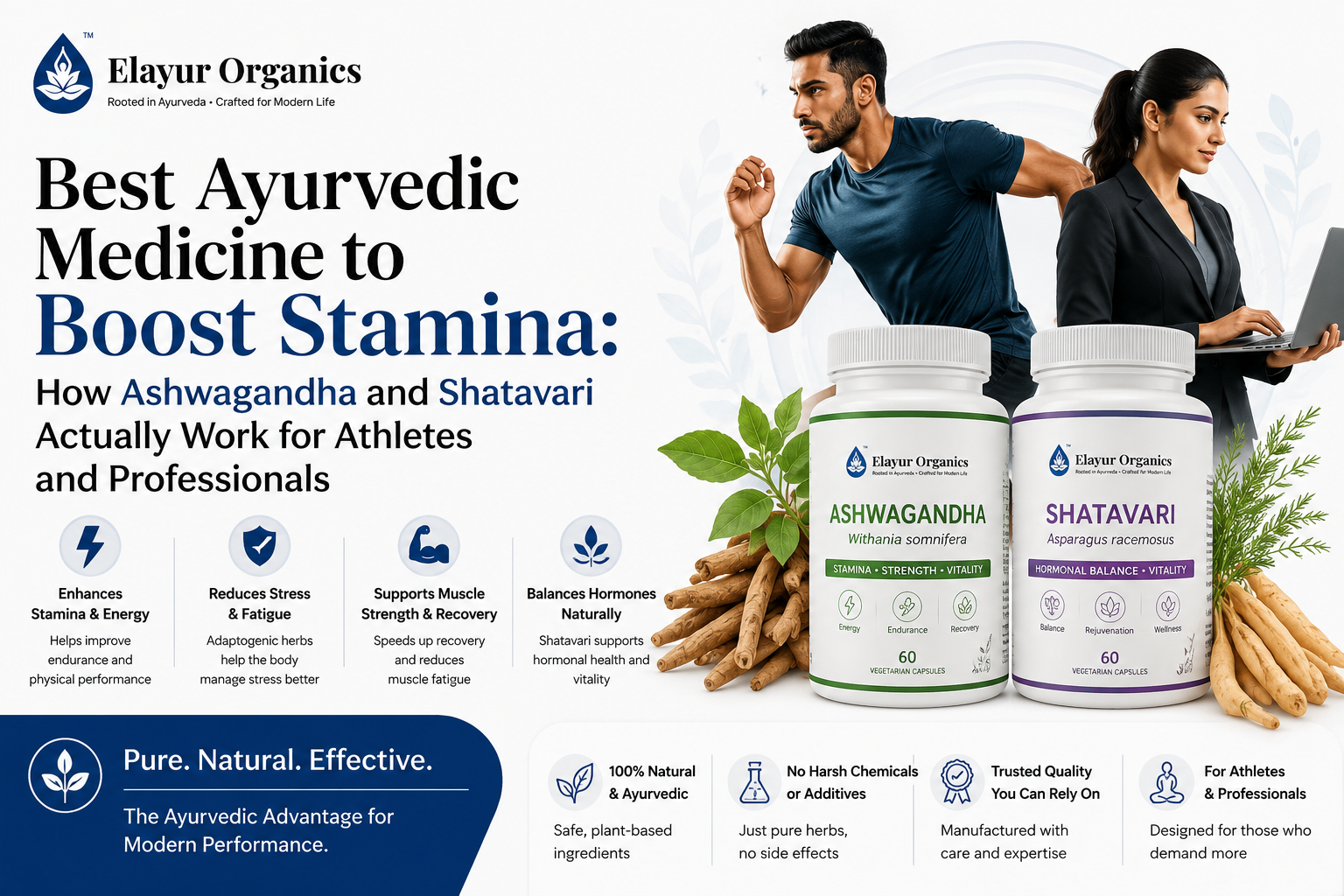
Best Ayurvedic Medicine to Boost Stamina: How Ashwagandha and Shatavari Actually Work for Athletes and Professionals
The fatigue experience has been one of the most memorable moments of our lives. If you’re an athlete struggling to the limits of training as a professional, juggling an unending schedule, or just one who is constantly exhausted regardless of a balanced diet and adequate sleep, the quest for a sustainable solution to energy issues eventually brings many users to Ayurveda. This is a natural choice. Ayurvedic remedies to boost stamina and energy have been refined through many thousands of years, and the herbal remedies that make up its basis are studied with serious scientific curiosity.
However, Ayurvedic stamina supplements have also been made a market category, and the market is overflowing with various products with wildly different qualities. This article helps cut through that clutter. The emphasis is on the herbs and formulas that have a proven record of success, the way they perform as well as what is important in deciding between them.
How Ayurveda Approaches Stamina Differently From Conventional Supplements
A majority of the energy supplements used in conventional medicine work by stimulating caffeine, B-vitamin complexes made of synthetic ingredients, and precursors of neurotransmitters, which cause a brief condition of increased alertness. This effect is genuine; however, the effect is borrowed. When you go up, it goes down the same way, and repeated use frequently results in dependence and decreases profits.
The approach of Ayurveda to stamina is founded on a distinct structure. It’s not about stimulating the body, but about creating Ojas, which is the Sanskrit expression for the vital substance that is the basis of physical endurance, mental clarity, and resiliency. The herbs in the Ayurvedic tradition to boost endurance are generally classified as rasayanas (rejuvenatives) or adaptogens. These are substances that assist the body in managing its stress response, enhance energy production at the cellular level, and also improve the efficiency of recovery from physical exertion.
The distinction is crucial. These herbs aren’t able to give you the same immediate rush of caffeine. Their effects are cumulative over a long period of usage, usually four to eight weeks. That’s the reason that many who have tried one time and don’t see any noticeable effects aren’t able to dismiss them before.
The Herbs With the Strongest Evidence for Physical and Mental Stamina
Ashwagandha (Withania somnifera)
Ashwagandha is one of the most thoroughly studied Ayurvedic plants for stamina and with good reason. Many clinical studies have shown the effects of this herb on VO2 max (a crucial indicator of endurance to the heart) and muscle recovery times as well as cortisol control. In the case of athletes, the combination with improved endurance and reduced injury to muscles from exercise is especially pertinent. Professionals who well-documented the effects of anxiolysis translate into better, more durable mental energy throughout lengthy working hours.
We’re saying that? Because the majority of people will hear ashwagandha and think of stress relief and then stop. The connection between stamina and endurance is real and supported by research, but the effect only manifests when taking the correct supplement and a consistent dose. KSM-66 as well as Sensoril are two well-known forms that have solid research backing their use. If a product isn’t clear what form it’s in or how much withanolides it contains, it’s important to consider before purchasing.
Shilajit
Shilajit is not as well-known for general people, yet it holds an essential position within Ayurvedic endurance medicine. It is a mineral-rich resinous compound that can be found within Himalayan rocks, shilajit’s principal active ingredient is fulvic acid. It increases mitochondrial function, the cell machinery that is responsible to produce energy. Studies on men have shown an increase in total testosterone as well as free testosterone and other fatigue-related markers that are correlated with exercise utilization. If you suffer from stamina problems, and are a result of hormonal issues the treatment is one of the best options for addressing it.
Safed Musli (Chlorophytum borivilianum)
Safed Musli is a well-established tradition of Ayurvedic sport medicine, particularly. Saponins are linked with increased physical performance, speedier recuperation, and effects similar to that of ashwagandha, in certain research studies. The ingredient is often used in the formulations of compound formulas targeted at athletes, and it’s considered to be less sedative than ashwagandha in people who are sensitive to this effect.
Shatavari (Asparagus racemosus)
Shatavari is usually linked to female health However, its value extends equally to males in situations that are characterized by physical decline. Its main application in stamina is for recovery. It helps to improve adrenal function, decreases the oxidative stress caused by exercise, as well as has properties for immunomodulation which are important for those who train intensely. Continuous intense training can degrade immunity; shatavari partially counteracts this.
We’re going to tell you why: Shatavari gets quietly overlooked in discussions about performance due to its long-standing connection to women’s health. It’s a missed chance. If you’re working hard but discovering that you’re catching each season’s illness or that your recovery period gets more, immune and adrenal assistance is usually the source of this issue as shatavari is a direct remedy for the two. It’s also one the most gentle herbs in this group, which makes an ideal addition to individuals who feel stronger adaptogens are also stimulating.
Gokshura (Tribulus terrestris)
Gokshura is utilized as a component of Ayurvedic practices to improve the endurance of women and for boosting their reproductive health. Evidence for testosterone elevation for healthy men is less in line with what marketing typically asserts. However, its impact on energy metabolism as well as kidney health, specifically pertinent for athletes who have excessive fluid intake is better supported.
Classical Formulations Worth Knowing About
Chyawanprash may be the most widely consumed Ayurvedic remedy within India. It is based primarily on amla (Indian gooseberry) which is among the highest vitamin C-rich foods well-known, it blends a variety of plants in honey-based powder. The benefits of amla for energy and immunity have been proven through the traditional usage and current studies. In the case of professionals, rather than athletes It’s among the most practical options for daily use.
The traditional mixture of Ashwagandha Churna along with Shatavari and Vidarikanda is found in a variety of commercial formulations that focus on the physical strength and vitality of males. This synergy targets adrenal fatigue, recovery from anabolism and the regulation of the nervous system at the same time.
Makaradhwaja is a well-known gold-based treatment used for situations of extreme debility as well as chronic fatigue. This isn’t a supplement for casual use that requires Ayurvedic consulting, however its benefits in cases of real exhaustion can be clinically important.
How Actually Determines Whether a Product Works
The formulation or herb is just one element of the formula. Standardisation, bioavailability and the quality of manufacturing determine if what’s listed on the label corresponds to the actual dose your body gets.
Some practical aspects to consider in evaluating products include:
Standardised extracts indicate the proportion of active substances. Ashwagandha extracts should include the amount of anolide (typically 5 percent for KSM-66) and shilajit needs to mention the fulvic acid content. Items that only list ashwagandha root powder without the standardisation process are hard to judge as they are inconsistent across batches.
The importance of testing for heavy metals is especially for mineral-based formulations. Contamination can be a major issue in less-than-quality sources. Be sure to look for products that have tests conducted by a third party.
Dosage amounts are crucial. The typical dosage for research on Ashwagandha is 300- 600 mg of extract that is standardised daily. Anything that is dosed much lower than that range will not cause the same effects as those observed in clinical research.
Inconsistency with time is the main mechanism. Ayurvedic stamina herbs do not function as quick-acting performance enhancers. They require a steady use in order to create the effects of adaptogens. The most realistic time for testing can be between six and eight weeks of continuous usage before testing the results.
Closing Thoughts
The ideal Ayurvedic treatment for stamina does not consist of an individual herb or one product. It’s the perfect combination of properly sourced, properly controlled ingredients that are consistently used over a duration and best aligned with the pattern you’re experiencing. Ashwagandha and shilajit are among the top choices for individuals due to the strength of their scientific evidence. Complex formulations such as Chyawanprash are ideal for those seeking an overall approach to a daily tonic.
If you’re interested in quality Ayurvedic stamina remedies, Elayur Organics offers formulations designed around these herbs with a solid scientific basis, which can be a valuable reference in your research of what will be the best fit for your requirements. Whichever you decide to use, however, the basic principles remain the same: top-quality sources, proper dosage with enough consistency so that the herbs perform the job they’re designed to do.




Add comment